Your license tags are due, but your check engine light is on.

Your check engine light has been on for 3 months and now it’s time to go to emissions. You already know why the check engine light is on. You had an auto parts store do a free code check. ???  Making the repair is going to cost money, but the repair is needed to get your new tags.

ADEQ

Tony’s Service Center participates with the Arizona Emissions repair program ADEQ. The ADEQ program helps car owners pay for the emissions repair. AZ pays up to $900 for repairs. The average emissions repair is around $1,200. Remember, any help is good help.

How do you get on the ADEQ program?

ADEQ Program

ADEQ Program step 1

ADEQ Program step 1

ADEQ Program step 2

ADEQ Program step 2

ADEQ Program step 3

ADEQ Program step 3

ADEQ Program step 4

ADEQ Program step 4

Is it easy?

Yes, yes it is. Tony’s Service Center is here to help with your emissions repairs. Give us a call today. 602-264-9866.

The main takeaway: Some emissions issues don’t get fixed. Why will clients give up on the repair? It’s all about the cost. I have some clients say no to repairs because of the age or condition of the car. Buying a new car or getting a newer used car in better condition is always an option.

I look at it this way. If an emissions repair is under $2,000. you should fix the car you own. You will never buy a good car for $2,000.

Fix your old car, if it’s in good shape.


PROJECT BUILD PAINS! What are automotive growing pains?

A new project rolls into the shop. It is a simple task. A 65 Mustang that needs the rear drum brakes changed over to disc brakes. Simple, easy and painless.

NO! No it’s not…

Project cars can be easy, but not without complications. Many jobs on older project cars and trucks can go smooth, but… Some times they have a mind of there own.

Things that cause the most issues are parts availability and the quality of the parts available. This 65 Mustang is on upgrade #6 a rear drum to disc conversion. The after market brake kits have a wide range of prices. Price is related to the overall quality of the parts in the kit.

Little red 65 Mustang.

1st: Take it apart and see if the axle shafts will be ok to be used with disc brakes.

Old drum brakes with axle in place

Too much runout at the flange will require new axles to be installed. Yep, they are bent. 🙁  A dial indicator is used to confirm that they are bent.

Taking a runout reading on a brake rotor.

2nd: After replacing the axle shafts, new bearings and seals. Plus a dry fit check of all brackets it was time to do the final machine work on the rotor with the new axles. Even with new axles, the flange still has a small amount of runout, but it was way better than the old bent axles. Below is a video for an on the car machine I use to machine the rotor true to the axle flange.

On the car rotor turning machine, used to cut the surface of the brake rotor bringing the surface true to the axle flange.

3rd: Once the rotor is machined all the remaining parts can be installed. Bleed the brake system, check for leaks and test drive for normal operation.

Caliper installed on ford 8 inch differential. Parking brake cables installed.

Rotor, caliper and spacer installed. Almost ready to bleed the brakes.

The instructions stated that the average working time was 3.5 hours. NOT! Actual working time was over 8 hours and 4 delays for parts that did not fit or needed to be fitted to the car.

No, the job did not go smooth. The job was finished and it worked correctly, but… It needed more. More vacuum boost. The boosters job is to help you push your brakes. It adds assist to the foot pressure you are applying.

Master cylinder and 9 inch booster.

So, even though the brakes worked good. The effort to stop the car needed an upgrade.

A bigger 9 inch booster and a over boar 1.25″ inch master cylinder plus 6 more hours of labor did the trick. New lines and bleed out the brakes again! Test drive and check for leaks one more time.

Done.

TSC Logo – Tony’s Service Center Phoenix, AZ 85016


It’s time for an oil change, it’s been how long?

Why wait to change your oil?

The date on the old filter is from June 2024 and I only got about 2 quarts of oil out of the engine. Waiting on an oil change is an engine killer.

Forgetting to service your car can lead to an inconvenient breakdown or catastrophic failure. Too busy, forgetful, personal issues? It does not matter to the car, it still needs service to keep going.

Keep up on service and your car will get you where you need to go.

Aftermarket parts cost less for a reason.

Today I had a Toyota Tacoma client pop in for an oil change. I see this truck about 4 times a year for service needs. The client keeps the truck clean and up to date on all service needs. A year ago the truck was in fender bender and the OE headlights got crunched. The client came in with some aftermarket headlight units and had us install them. I mentioned that the aftermarket plastics don’t hold up in the Arizona heat. The client said he saved a lot of money and they look fine to him.

14 months later they look like poop! The plastics are hazed over, but not on the outside. This issue is on the inside, you can not fix an inside issue. You have to replace them again.

The end story is the aftermarket parts are less expensive because they are a lower quality part. They look the same, but upon close inspection, they are not the same quality.

Aftermarket parts are a problem. Many do not fit correctly, plus the over all finish is not O.E. level. They just do not last as long…

When ever I can, I try to get the client to see the value in using factory parts when ever possible. This is not to say all aftermarket parts are poor quality. We use many aftermarket parts that match OE quality.

When we know that an aftermarket part is ok to use, we use them. We are always watching out for the client. In turn we do not want to use a part that will fail. If the aftermarket part can not meet our 3 year 36,000 warranty we do not want to use it.

We install many O.E. parts on clients cars.

The end game is to fix the clients vehicle correctly and offer a repair that lasts.

HeyAnthonyAz.com

Brake pad noises and wear out explained

Brake noise is a common part of brake operation. A majority of the time you will hear nothing inside your vehicle. Worn brake pads can make noises you would hear inside your vehicle. The most common noises are a crunch or runch sound. Another noise you may hear is a high pitch shriek. Shriek noises are very common with very worn brake pads or budget “cheep quality” brake pads, even if newly installed.

I like to install OE dealer brake parts when ever possible. OE parts fit correctly and offer the best noise control for the life of the brake pads.

When grinding noises happen every time you press the brake peddle. Your brakes are 100% worn out. the metal part of the brake pad is making contact with the metal brake rotor.

The service “wear out” specs on brake pad thickness can vary from 1mm to 2mm. Brake wear sensors will normally turn on the dash brake wear light around 2mm.

Brake pads that use a noise tab built into the pad, may make a high pitch noise only when backing up, but quiet going forward.

When I inspect brakes for wear, I look at the thinest brake pad to judge the wear % remaining. Once below 30% remaining life (around 3mm of pad thickness remaining) brake replacement will be needed soon.

If you are noticing brake noises, stop in at your local repair shop and have them inspect your cars brakes. Waiting to see if the noise just goes away can cause bigger issues.  If the brake rotors or brake calipers become damaged from metal to metal contact it can increase the cost of your brake repairs.
HeyAnthonyAZ.com


Before you buy a used car, get it checked out.

Always get a used car checked out before you buy it. Once the papers are signed and money is paid. The chance that you will get any money back when the poop hits the fan, is close to 0%

Bring your car to any ASE mechanic and they will tell you if it’s ok to buy. It is important to use a 3rd party service for your inspection. A friend or some gear head buddy may miss things that would be noticed by a professional mechanic.

HeyAnthonyAz.com

Just stop in!

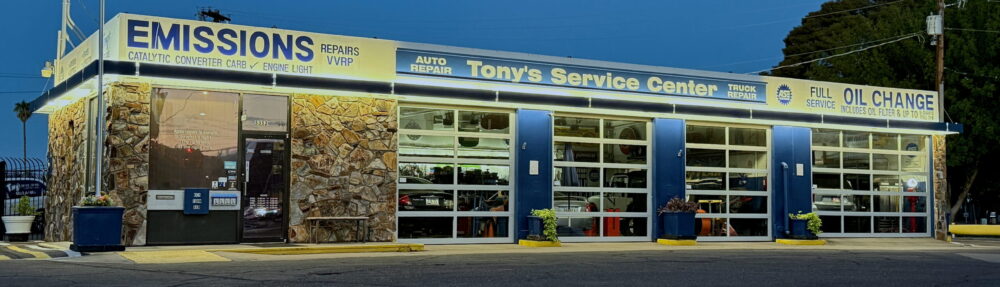
We are your friendly Neighborhood Garage, just stop in.

Too many times I hear this phrase, “I was driving by and you guys looked so busy.” Don’t wait, just stop in. I hear this one too, “I didn’t think you had time to look at it.” Don’t wait, just stop in. We are your friendly neighborhood garage and ready to help. Maintenance ignored leads to a break down on the road. Nobody likes sitting at the side of the road waiting on a tow truck.

Do you have a funky noise? We can look at that. Is it time for service? We do service work on all makes and models. A no start problem is no problem at Tony’s Service Center. Just stop in, we fix broken cars. Car care is a part of owning a car. Car repairs will happen and you need to be ready. Just stop in and say hi.

Need an oil change today?

We use a “synthetic blend” as our standard oil. Servicing you car is the most common reason to visit a repair garage. We use a synthetic blend because it extends the oil life, offering better protection against wear and resists carbon coking. If your car needs full synthetic we stock that too.

Regular motor oil: Regular oil works great for older engines, but if you do not service it regularly and or ignore your service intervals. It can lead to heavy carbon build up “hard sludge” or coking of the internal engine parts. “Coking aka soft sludge” “Coking” is characteristic of a high temperature reactions involving hydrocarbons. On todays small high revving engines, carbon deposits may cause restricted oil flow, shortening the life span of your engine.

Full Synthetic motor oil:  Synthetic oils primary use is in high heat stress applications like Arizona. Jet engines use Synthetic oil. Synthetic oils are great for cold climates too, it will flow normally even in freezing temperatures.  European cars, motor cycles and many of todays small turbo charged engines need full synthetic oils to prevent sludge and carbon build up.

Just stop in and let us know how we can help. 

HeyAnthonyAz.com & TonysServiceCenter.com


Fuel Economy

When an alternator decoupler pulley fails, the alternator may still be producing the correct volts and amps. The decoupler pulley is a “one way clutch”. When an engine is at a cruising RPM of “3400 RPM” and the engine suddenly drops to an idle around 800 RPM the inside moving parts of the alternator do not have to slow down at the same time as the engine. Mass in motion stays in motion. The one way clutch or “decoupler” allows the rotating mass “heavy parts of the alternator” to rotate freely, independently of the engines drive belt. This decoupling pulley reduces the flywheel effect placed on the engine and the engines drive belt. When the decoupler goes bad. Fuel economy will be reduced.

I have clients that think they need a tune up because they are not getting the same fuel mileage as they use to and it turns out the one way clutch on the alternator could be the cause. Many things on todays car can be broken or very worn and you will never know they are bad. Some broken parts will never turn on a check engine light. During a major service interval, I may have the drive belt off during the service and that is the best time to inspect the alternator decoupler.

I have had some clients, that watch fuel mileage for work related jobs. Tell me that they noticed up to a 1.5 MPG change after replacing the faulty decoupler. That may not seen like that big of a deal, but over a years worth of driving it adds up.

HeyAnthonyAz.com

Lemonade

You just bought a used car.

It’s your first week of driving your “new, used car”. Yep, its new to you, but it’s still a used car. Everything seems great, but a couple of things are bothering you. A click sound from the front end, the radio does not lock on your favorite station and the A/C just does not blow cold in the middle of the day.

You think to your self, maybe I should get this car checked out. Plus it may need other things. So a visit to the repair shop should shed some light on the small things that you have noticed so far.

“You should always get a car checked out” before you sign the papers or lay down your money for your new ride. A proper inspection can save you money.

Just because you took a friend or a person that knows cars with you when you went looking for cars does not protect you from a lemon. An ASE mechanic can see the red flags. A lemon is not that easy to identify, but the red flags will still be seen better by an auto technician vs a friend. Repair tech’s will look at a car with an objective pair of eyes. I know when I look at a car for a pre-purchase inspection, I have no attachment to it. I only care about one thing. “Is it worth the price being asked.”

KBB.com is a great place to find out what a car is worth.

The color and style are not factor during an inspection. The only thing that matters to me is, “is it worth the money.”  So I look at 3 key factors during an inspection. 1: Is the car safe. 2: Does it drive the way it should if it was brand new off the showroom floor. 3: I look all over the vehicle for hidden damage, neglect, missed fluid services or maintenance and modifications that will affect the overall life of the vehicle.

Aftermarket and remanufactured parts are a double-edged sword. Some are great and work just like the original equipment part. My focus is on the “crappy parts” that cause early failures. Cheep aftermarket parts can cause vibration, leaks and fit issues that could lead to an on the road brake-down. I will not use an aftermarket part that can not last at least “3 years or 36,000 miles.” I would not use a part on my own vehicle that could not at least make it that long. I do not like doing repairs twice.

3 years or 36,000 miles

At Tony’s we use lot’s of dealer parts and high quality select aftermarket parts. The aftermarket parts must last as long as the original equipment part should for us to use them. Dealer parts last a long time. In most cases the OE parts will last just as long as the originally installed part did. Some aftermarket and remanufactured parts don’t last as long as the OE parts, but they should last at least 3 years or 36,000 miles.

Time to go shopping.

Shopping for a car is not a big deal because your going to bring the vehicle to Tony’s Service Center to get it checked out before you buy it. Well that’s what I recommend. The things you need to look for when you are deciding on a used vehicle are the following items.

1- Go and look at vehicles during the day when the sun is up. Sun light will help you see paint flaws easier. The heat of the day will let you check the A/C for correct cooling. Check the heat, cooling and all modes of the controls. Everybody needs A/C in Arizona!

2- Does the car smell bad when it sits closed up in the heat. It may look clean, but is it? It could have been in a flood and it was cleaned up really good. Smells like mold, pet dander and smoking can linger even after a pro level detail. Close the car up and let it sit in the sun for an hour. Then go check for odd smells.

3- Drive it for 3 miles city and follow it up with a 5 mile freeway drive. You may have to spiff the sales man 20 bucks to make this happen, but it is worth it. Pay close attention and listen for road and wind noises with the windows up. Next listen for clicks and rattles, drive next to a brick wall with windows open for this part of the drive. Go drive it hard on the freeway, full throttle accelerations and hard stops. If it has an issue getting up to speed or stopping, you need to know before you bring it to me for an inspection. Check the cruse control and other options installed. Lastly anyone that rides with you, have them shut up and be quiet. Jabbering on can pull your attention away from what the test drive is for, finding flaws. Better yet, go drive the vehicle by your self.

4- Let the engine idle for 20 min with the A/C on max air. This helps check for A/C issues or poor cooling at the ducts. Take a thermometer with you so you can see what the duct temp is, your hand is not an accurate guide. Any temp higher than 58 degrees on max air settings is no good.

5- After the 20 minuet idling, give the throttle a good brisk snap, rev the engine up over 4k RPM’s and check to see if any blue smoke kicks out the tail pipe. Blue smoke indicates engine wear. The engine has not been serviced correctly or its worn out.

6- If all of the above things check out good. Its time to bring the vehicle to a repair shop for a full inspection of all hidden factors and a ASE tech to shake it down. At tony’s Service Center we charge for the inspection, but its worth the money and time you will spend.

HeyAnthonyAZ.com

2010 Dodge Challenger R/T 5.7L HEMI with 28,000 miles on it. All service intervals have been over looked. It has been lowered and has non factory wheels. It rides hard, like a typical lowered car. It has aftermarket muffler’s and they drone very hard at 2000 RPM’s. The trans fluid is black and it has a clicking noise at the rear. Overall it’s in need. It is clean-looking on the outside. The inside is showing wear. This car is not in excellent condition, but this is what a typical used car will look like.


All new cars get old

Fact: Your new car will need repairs as it ages.

I have many clients that went out 5 years ago and bought new cars. Now that new car is aging and needs repairs. The Mustang below is only 6 years old and it’s already wearing out. Just because you buy a new car, you are not off the hook for maintenance.

2012 Mustang, out of warranty and in need of repairs. It has 157,000 miles on it and it’s worn out. The engine has been overheated, it burns and leaks oil, plus the front suspension is noisy over bumps.

Repairs will be needed to keep your car working correctly. Wear and tear from heavy use will bring you back to the repair shop. Worse yet, what if you breakdown and have to be towed in for repairs.

Warranty or no warranty, regular servicing and breakdown repairs are going to happen.

The first thing I tell clients is to have an emergency repair fund stashed away. I have cash stashed in my saving just for this type of thing. I have been stuck out-of-town before and cash is king.

The second thing I tell clients is to have a AAA gold card. The gold card is great if you travel out-of-town and need a tow. The gold card gives you all the road side assistance that you get from a normal card, but your free towing is now 100 miles vs 5 miles.

The VW on the left is being towed away today because it needs an engine replaced at $6,200. The VW on the right was just purchased by a client that did not want to overhaul an A/C system on a 10-year-old Honda CRV. Both VW’s are 2015 models and they both have around 40,000 miles on them.

Even if your car is brand new, you should get it serviced before any big trip out-of-town.

The idea is to prevent a breakdown. I have seen brand new cars with major flaws that need repairs.

ASE tech’s will notice wear and age issues that could cause a breakdown way before they become a failure on the road.

Get your car inspected before you hit the road.

One week before you travel, take your car in for service. Even if you’re not due for service, get your car looked at before you hit the road. If your car has any repairs that are needed, the repair shop has time to get them completed before you need to leave town.

2014 Nissan Rogue, with 52,000 miles on the clock. This one came in on the hook. An overheated cooling systems caused an engine failure. Leaks like this can be repaired way before they become a failure on the road.

If you have an older car and it’s too worn out to leave town. Rent a car for your trip. It’s less expensive to rent a car for the weekend than it is to be broken down on the road waiting for a tow truck.

This belt is from a 4-year-old car with 57,000 miles on it. I was installing a new alternator and I advised replacing the belt while it was off. The belts cost was $34.00. The client said no to replacing it. Oddly they let a friend use the car for a week and the belt came apart, allowing the engine to over heat. The driver drove the car till it stopped. The engine was destroyed.

Technology in cars today.

Todays car owners are spoiled by technology. 25 years ago most of the cars on the road visited the repair shop 45% more often than todays cars. Advancements in how cars are built is one reason why they seem to last longer. Service intervals are longer and many parts last a lot longer. 25 years ago most cars needed a tune up every 24,000 miles. Today most cars don’t need a tune up till 100,000 miles.

Do cars last longer?

Todays cars do last longer and they do cost more to repair. Belts and hoses look the same as they did 25 years ago, but now they cost 40% more to replace. Brakes are bigger, tires have changed and A/C systems costs are double what they use to be. When the parts fail, they fail big. The change in overall costs is due to the extra technology to run all the cool gadgets.

A hybrid car looks very cool in the show room, but jump forward 10 years when you have to replace a battery pack at $3,200. Turbo charged engines cost big with any failure. Cylinder canceling engines like some of the GM V8’s and now it’s new turbo 2.7L 4 cylinder engine they will be putting in full size trucks in 2019 cost a small fortune to fix when they fail.

Many failures will happen from age and normal use. Other failures will happen from bad advice and a failure to follow service intervals. Below is an image of what happens when the wrong parts are used to save money. Using the wrong parts can cost you more later.

This is what happens when budget copper spark plugs are used in place of double platinum plugs. Copper plugs cost $2.59 each. double platinum plugs cost $9.67 each. Times 4 on a 4 cyl engine. The plug savings caused 2 coils to fail plus a tow. This was done by a shop just 1 mile away from my shop. The correct repairs cost 3 time what the original tune up did, plus an 18 mile tow.

I have over 4 dozen clients that “ignore” the service intervals on their cars. When they have to be towed in and whine about the tow. I just tell them that better service intervals could have prevented the failure.

98% of the time I am 100% right. 3 Service intervals a year will go a long way to prevent breakdowns on the road.

Just because it’s new does not insure you will not have a breakdown. Let us help you keep that new car new or make your old car feel new again.

Heyanthonyaz.com